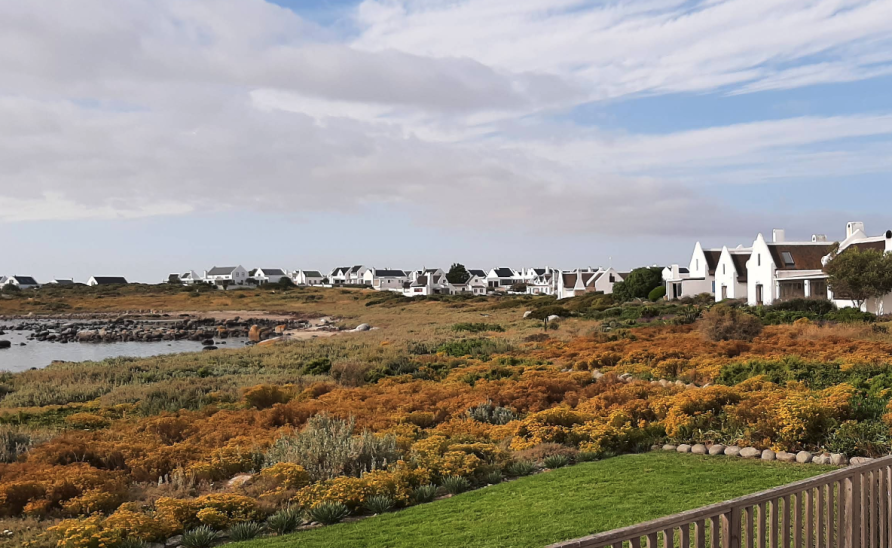
A West Coast weekend getaway works best when the house does the entertaining. Sunset-sea is a self-catering beach house that sleeps your whole group, pick a season for the mood you want, plan one proper meal a day and leave the rest empty. Sunset-Sea sits on the sea at Mauritzbaai in Jacobsbaai (Jacobs Bay), about 90 minutes north of Cape Town, and sleeps eight over four Bedrooms and three bathrooms.
Most milestone weekends fail for the same reason: someone builds an itinerary. The 50th becomes a schedule, the reunion becomes logistics, and the person who organised it spends three days managing instead of just being there.
The fix is the actually venue, not the plan. Get eight people into one house on the water, with a kitchen big enough to cook in together and a deck facing the sunset, and the weekend runs itself. This is what we have learned.
At a glance
- Where: Sunset-Sea, Mauritzbaai, Jacobsbaai (Jacobs Bay), Cape West Coast, Western Cape.
- Drive: about 90 minutes from Cape Town, up the R27.
- Sleeps: eight, in four bedrooms and three bathrooms, two of them en-suite.
- Best for: milestone birthdays, small family reunions, anniversaries, and any gathering where the point is the people.
- Minimum stay: two nights standard, seven in high season.
- A public holiday stay must cover the full long weekend.
- Well-priced rates: the winter band, 30 June to late July. Midweek is cheaper than weekends year-round.
- Dogs: two, by prior arrangement.
What kind of celebration suits a self-catering house?
The ones where atmosphere matters more than activity. If your gathering needs a stage, a sound system or a seating plan, book a venue. If it needs a long table, a fire and nowhere to be, book a house.
The gatherings this house suits:
- Milestone birthdays. The 40th, 50th, 60th and 70th that the person did not want a party for.
- Small family reunions.
- Six to eight people, three generations, everyone under one roof without anyone sleeping on a couch.
- Anniversary weekends, either just the two of you or with the friends who were there at the start.
- Mother’s Day and Father’s Day, where the group runs from toddlers to grandparents and everyone has to be comfortable at the same time.
- The quiet ones. A retirement, a new job, the end of a hard year. No cake, no speeches, just the people who should be there.
The ceiling is eight guests. Eight people to fit around one table and hold many conversations, whatever they may be.
When should you book a weekend on the West Coast?
There is no bad month here, but the season sets the mood, and the mood is most of what you are booking. Pick the one that matches the gathering.
Winter, June and July: fires, storms and the whole coast to yourselves
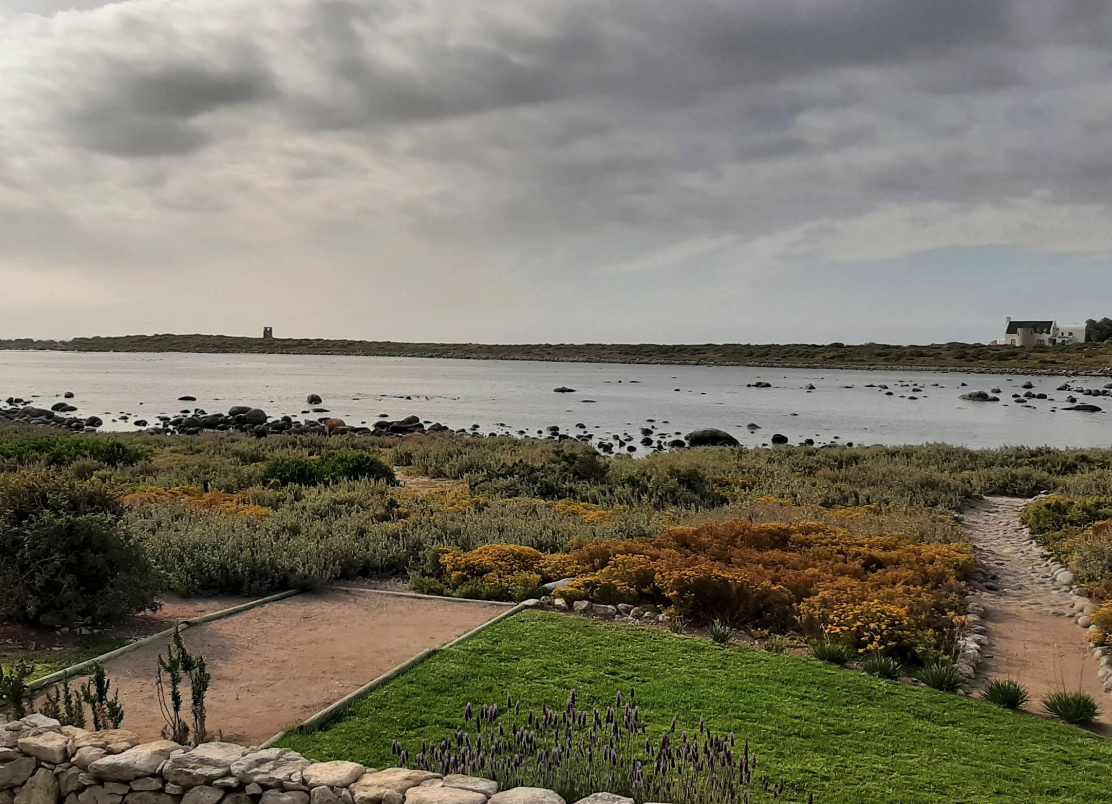
This is the underbooked one, and for a milestone weekend it might be the best. Rainstorms come in off the Atlantic and you watch them through the windows with a glass of red in your hand, which is a better evening. The indoor fire earns its keep. The beach is empty. The pace drops without anyone deciding it should.
Two practical things. The sun goes down early in midwinter, so plan supper around the sunset rather than the other way round. And the winter rate band, 30 June to late July, is the lowest of the year, so the same house costs meaningfully less than it does in December for a weekend that arguably works better.
The West Coast shows its character in winter. Most people have not worked that out yet.
Spring, August to October: wildflower season
The ground turns over into carpets of orange, yellow, white and purple, and Jacobsbaai sits in the middle of it. The Postberg section of the West Coast National Park, about an hour south, opens for the flowers from 1 August to 30 September 2026, and the Darling Wildflower Show runs 18 to 20 September 2026.
Two things worth knowing before you plan a day around it. The flowers open with the sun, so late morning to mid-afternoon is the viewing window, and they stay closed on cold or overcast days. Check the forecast.
Expect daytime temperatures of 11.9 to 15.7°C in August and 12.8 to 16.7°C in September, with the sea at 14 to 15°C. Pack layers. This is the busiest season of the year and it fills earlier every year, so a spring celebration is one to book months out, not weeks.
Summer, November to March: long days and late evenings
Dry, warm and bright, with the light holding well into the evening. The southeaster picks up through the afternoons, hardest in November and December. December and January are the school holidays and the village fills, though never the way Paternoster or Langebaan do.
February is the sweet spot: still warm, less wind, the crowds gone. If your milestone is flexible and you want swimming weather without December pricing, that is the month to aim at.
Autumn, April and May: the quiet one
The heat has eased, the crowds have gone, and the weather still holds. Mild days, cool nights, very little rain. The light is the reason to come: long golden afternoons and night skies full of stars you do not get in the city. Some restaurants run reduced hours, so check before you drive out for dinner.
What does the weekend look like?
Friday. You arrive with the light going. The deck faces the ocean and that is where everyone ends up first, before the bags are even in.
Nobody negotiates over bedrooms because the layout makes it obvious. Someone opens wine, the fire gets going, and that is the whole of Friday. It is enough.
Saturday morning. Coffee on the deck with the sea in front of you and nowhere to be. One or two people walk down to the water for a wander, and the rest of it is birdsong, waves and salt in the air. By nine someone is cooking in the farmhouse kitchen while the others drift to the dining table.
Saturday afternoon. The house splits itself naturally. If you want noise there is foosball, petanque on the lawn and a dartboard. If you want quiet there is a bedroom with a view and a closed door. The children disappear into the rock pools a few metres from the house, which means no driving, no entrance fees and no elaborate plan.
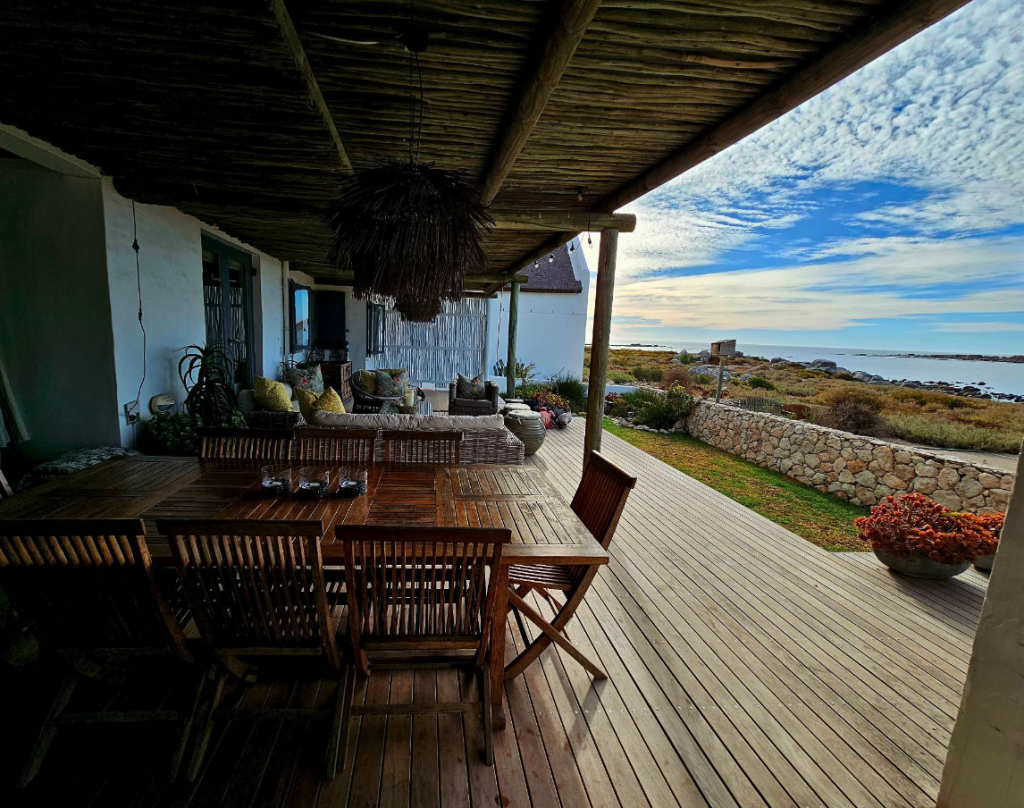
Saturday evening. The kitchen, the long table and the wooden deck are the anchors of this house. Someone is at the braai, someone is doing the sides, music is on, and by five the whole group has gravitated to the deck for sunset drinks without anyone calling it.
Then red wine, good food, and the sort of storytelling that only happens when there is nothing on anyone’s phone worth looking at. By 11 the fire is still going and nobody is ready to call it.
Sunday. A slow breakfast and some reluctant packing, and the quiet suspicion that two nights was one short.
How do you feed eight people without cooking becoming the weekend?
One proper meal a day, cooked together. Everything else casual. That is the whole plan.
The farmhouse kitchen is big enough that cooking becomes part of the gathering rather than a job somebody gets stuck with. There is a braai outside for the evenings the wind behaves, and one indoors for the evenings it does not, so supper ends in woodsmoke either way.
Stock up before you arrive. There is a small shop in the village for basics and not much more. Do the real grocery run in Vredenburg, about 15 minutes away, on your way in. And specially, a group arriving at seven on a Friday evening won’t be crisps for dinner, Sunset-Sea can organise your Checkers Sixty60 delivery before your arrival.
Send someone for seafood on Saturday. Paternoster is about half an hour up the road and it is the best-known food stop on this stretch of coast. A fresh catch on the braai on Saturday night is the closest thing to a plan this weekend needs.
Go out once, if you want to. One lunch or dinner in Paternoster breaks the weekend up nicely. Book ahead; the good tables on this coast go early, particularly in spring.
But the honest version is that the best meals happen at the house, and not because the cooking is better. It is the setting: the sea in front of you, no time pressure, nobody waiting on the table. That does not happen in a restaurant.
What is there to do, and how much should you plan?
Less than you think. The most common mistake groups make here is building an itinerary that leaves everyone tired.
What fills a weekend without anyone forcing it: beach walks, foosball, petanque, board games at the dining table, reading on the deck, and sitting watching the ocean do its thing. Then deck time at sunset, the fire lit after dark, and the smart TV with DStv and Netflix if the group wants rugby on or something for the children.
If you want one thing on the calendar, pick a single outing for Saturday morning and leave the rest empty:
- Walk the seven bays. The village is two kilometres of coastline broken into seven separate bays, and you can walk between them in a couple of unhurried hours. Best way to get your bearings on the first morning.
- West Coast National Park, about an hour south, and its Postberg flower section in spring.
- Paternoster, about half an hour away.
Pick two, and spend the rest of the time moving slowly.
Does it work for children and dogs?
Yes, and that is often what decides it for a family group.
For children, the rock pools do the heavy lifting. They are a few metres from the house, which means no packing the car and no entrance fees.
The pool has a cover and the house and garden are fully enclosed. There are a few small steps to the bedrooms and bathrooms, so the usual supervision applies. There is no cot and no infant extra bed, so bring your own for a baby.
For dogs, up to two medium-sized, well-behaved dogs are welcome by prior arrangement, at R600 per dog per stay. The garden is fully enclosed and guests bring their own pet bedding. For a group that would otherwise be arranging kennels, that is often the detail that decides it.
How does Jacobsbaai compare to Paternoster or Langebaan for a group weekend?
Paternoster is more developed and more polished, a food destination that draws weekend crowds from Cape Town. Langebaan is built around the lagoon and watersports: kitesurfing, sailing, plenty going on. Both are good. Both are busy.
Jacobsbaai is quieter than either, and for a celebration that is the point. There is less to do in the conventional sense, so the group stays together instead of scattering. Both towns are easy day trips from the house if you want an afternoon out, which means you get the quiet base and the busy options without having to choose.
If your group wants nightlife, book Paternoster. If your group wants one another, book Jacobsbaai.
What to know before you book
- The house sleeps eight, in four bedrooms: three queens, plus a double that converts to two singles on prior request. Three bathrooms, two of them en-suite.
- Minimum stay is two nights, seven in high season. If a public holiday falls in your dates, the stay must cover the full long weekend.
- Booking terms: 50% deposit secures the dates, balance due 30 days before arrival, free cancellation up to 30 days before arrival. There is a R500 cleaning fee and a R1,000 refundable damage deposit.
- Check-in is from 3pm with self check-in via a lockbox, and check-out is before 10am. Early check-in and late check-out can be arranged for a half-day fee.
- Starter firewood is supplied. If you are planning a fire every night of a long weekend, say so when you book.
- Direct booking discounts: 5% for four or fewer guests using two or fewer rooms, and 10% on stays of 10 days or more, outside high season.
- Signal is patchy depending on your network, though the house has uncapped Wi-Fi throughout. Most groups decide that is part of the point.
- Pack something warm whatever the season. The temperature drops the moment the sun does, and the Atlantic is cold all year. This is a swimming sea for the brave.
- Book early for the dates that matter. Long weekends, school holidays and the spring flower weeks fill first, and a milestone is not a weekend you want to move.
Frequently asked questions
What is the best month for a West Coast weekend getaway? Winter, roughly June and July, for fires, storms and the lowest rates. Spring, August to October, for wildflowers. February for warm weather without the December crowds. April and May for quiet and good light.
How far is Jacobsbaai from Cape Town? About 90 minutes, north up the R27. The village sits on the Cape West Coast between Saldanha Bay and Vredenburg, and is signposted from the Saldanha-Vredenburg road.
How many people does Sunset-Sea sleep? Eight, across four bedrooms and three bathrooms, two of them en-suite. Three bedrooms have queen beds and one has a double that converts to two singles on request.
Is there a minimum stay for a weekend booking? Two nights as standard and seven in high season. Over a public holiday the stay must cover the full long weekend, so a Friday public holiday means Thursday night through Sunday.
Can we bring dogs? Yes, up to two medium-sized, well-behaved dogs by prior arrangement, at R600 per dog per stay. The garden is fully enclosed and guests bring their own pet bedding.
Is the house suitable for young children? Generally yes. The pool has a cover, the house and garden are fully enclosed, and the rock pools are metres from the door. There are a few small steps to the bedrooms and bathrooms, and there is no cot or infant extra bed, so bring your own.
Where do you buy groceries? Vredenburg, about 15 minutes away, has full supermarkets. The village shop covers basics only. Do the main shop on your way in, or organise an order from Checkers Sixty60 before you arrive.
Can you cook for a group, or should you eat out? Cook. The farmhouse kitchen takes several people at once, and there is a braai indoors and out. Paternoster, about half an hour away, is worth one meal out over a weekend.
When you are ready
The weekends worth remembering are the ones nobody had to run. A house on the water, eight people, a fire going, and a Sunday that arrives too soon.
Check your dates and book direct at sunset-sea.co.za | We’re also a Superhost on Airbnb
Come and let the West Coast do what it does best.