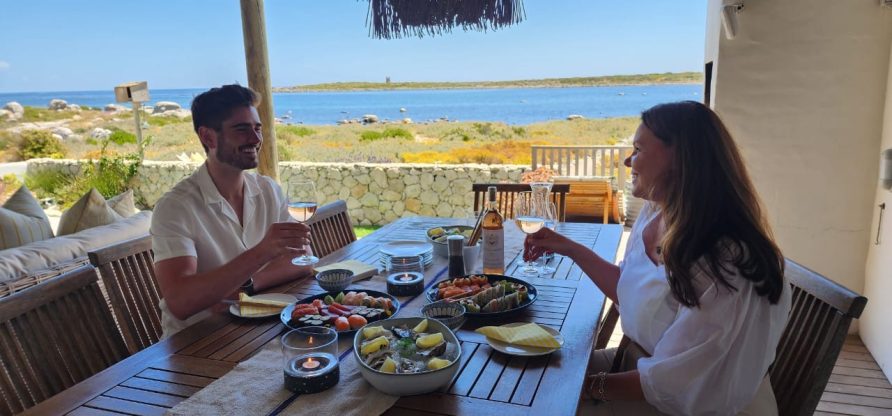
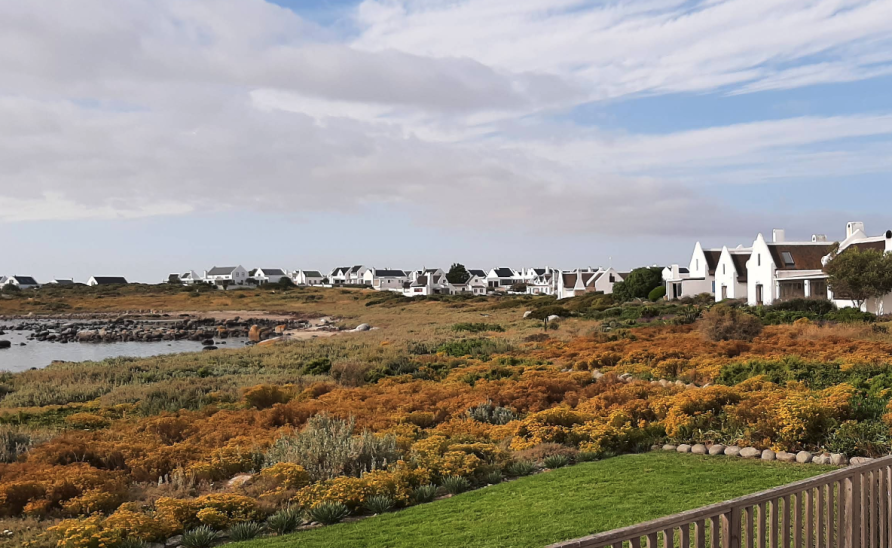
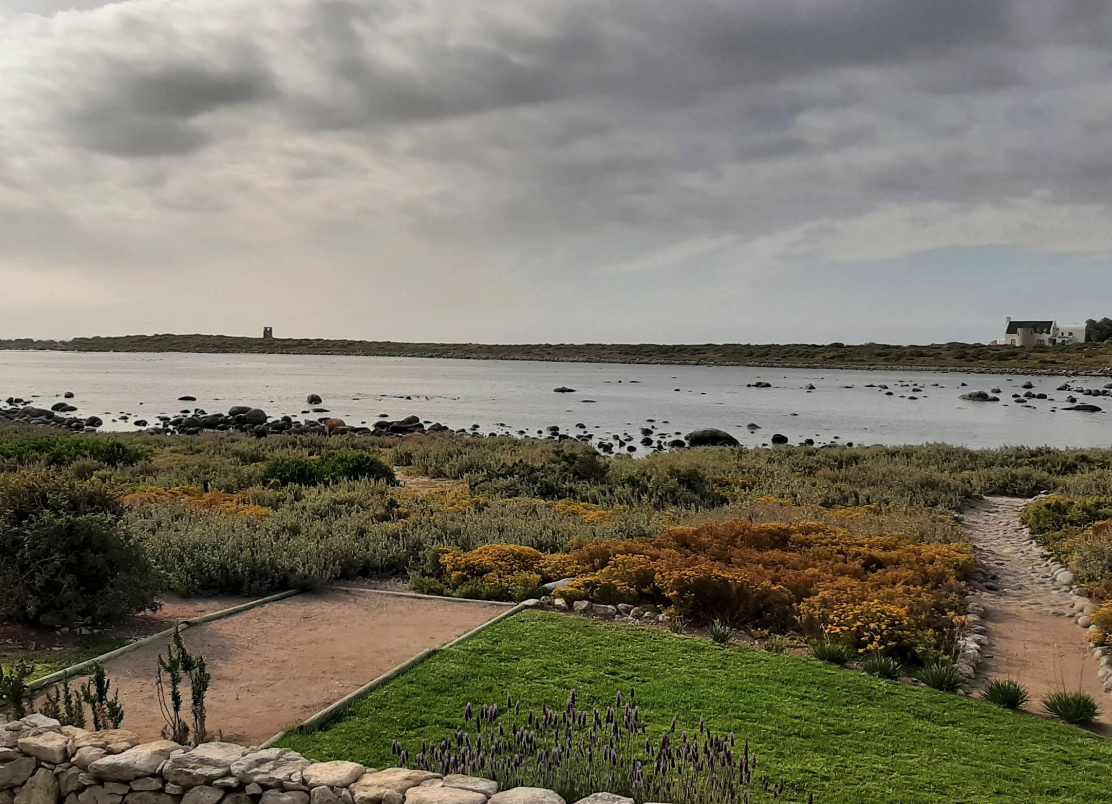
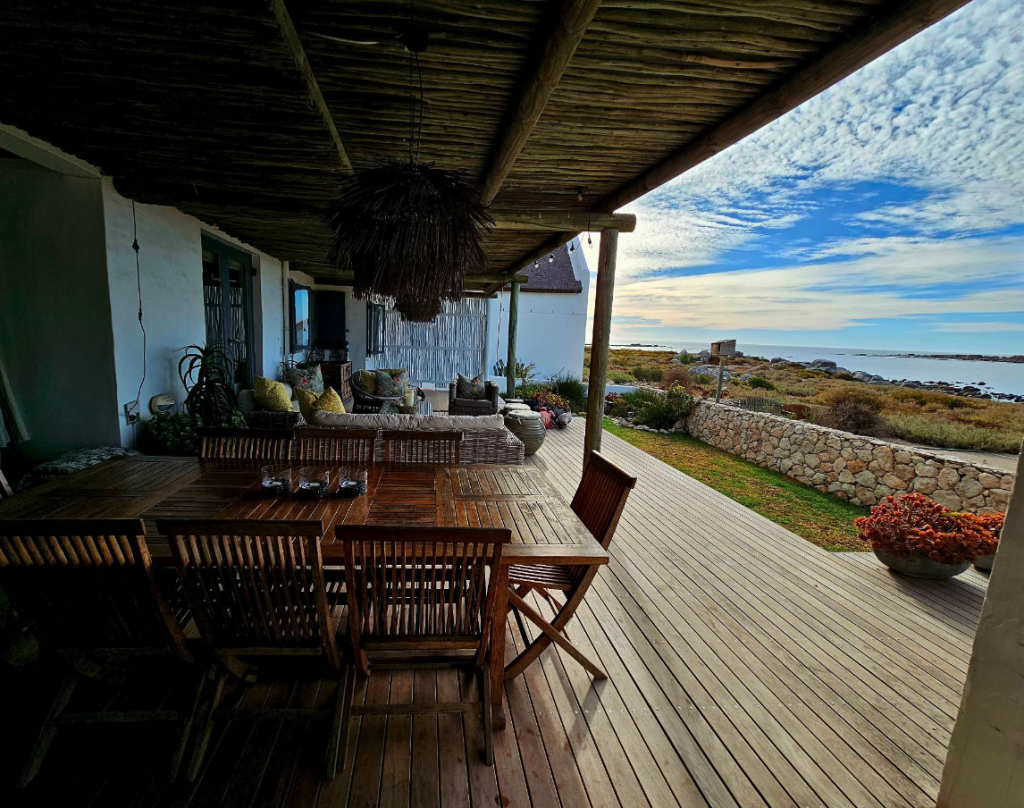
If you’re staying with us and wondering where to eat, these are the places we go to in Jacobsbaai. The village has two restaurants: Daai Plekkie in die Weskus, right on the sea, and The House of Bean and Leaf at the little village entrance. Beyond our village, each of the West Coast towns around us have a table worth the drive.
Where to eat in Jacobsbaai: the two village restaurants and what each does best
There are only two restaurants in the village, and each one has their own thing. At Daai Plekkie, you eat with the sea beside you. At Bean and Leaf, it’s seafood, soft serve, waffles and a terrace where your dogs can join you.
Daai Plekkie in die Weskus: on the sea, with a buffet breakfast
Daai Plekkie in die Weskus does pizzas, burgers and seafood. But what they do have is an amazing buffet breakfast on Saturday and Sunday mornings for R150.
On match days the rugby is on. It’s a calm place to sit, and the service is fantastic.
The House of Bean and Leaf: a little bistro, with soft serve and waffles
The House of Bean and Leaf is a little bistro at the village entrance, with an à la carte menu and food that is wonderful. They do insane ice creams and waffles, and dogs are welcome on the terrace.
Whenever we leave Jacobsbaai, as a reward for being in Jacobsbaai, we get ourselves a soft serve ice cream.
Ordering takeaways and eating them on the deck at Sunset-Sea
You don’t have to eat out. Sometimes the best answer to where to eat in Jacobsbaai is on the Sunset-Sea deck. We keep The House of Bean and Leaf menus at the house. Phone your order through and collect it; it’s only a short drive.
Then bring it back and eat with the bay in front of you and the sound of the sea close by.
Where to buy bread, jams and cheese-board spreads in Jacobsbaai
Karmenaadjie Farmstall and Bistro is just as you drive into Jacobsbaai. They do jaffles, the old-school toasted sandwich sealed at the edges, and sell farm-stall goods. They stock jams and other goodies for a cheese board that will be well worth the stop. It’s open every day except Tuesday, from 8.30am to 5.30pm on weekdays and 8.30am to 3pm on weekends.
Langebaan: sushi to take away, pizza on the lagoon and lunch at Shark Bay
Thoban Chefs: some of the most delicious sushi
We normally order from Thoban Chefs on the drive from Cape Town. We order on WhatsApp about 20 minutes before we hit Langebaan. Then we pick it up, drive to Jacobsbaai and have our sushi on the deck. It’s so easy.
They’re very well priced, and there are also other dishes for anyone who doesn’t eat sushi, including their sweet and sour chicken. They’re open every day from 9am to 10pm, and until 8pm on Sundays. Their WhatsApp number is 076 855 6201.
Shark Bay Boutique Hotel, for lunch or breakfast with the kids
For a day with the kids, Shark Bay is an amazing spot. It’s a little smarter, but the water is shallow and there are no major waves, so it’s easy with small children. The Shark Bay Boutique Hotel serves lunch and breakfast, and you can even do stand-up paddling.
Saldanha: oysters on the sand at a harbour oyster bar that opens only a few days a month
The oyster bar at Saldanha Wine & Spirit Co sits right on the sand, overlooking the harbour. You feel like you’re in Mozambique. They serve oysters, mussels, roosterkoek (bread rolls baked over the coals) and sherry.
It opens only on certain days, sometimes only twice or three times a month, so check before you go. Last summer it opened on Saturdays in January, from midday until 7pm. You can also book on Dineplan.
Paternoster: a matinee at Die Koelkamers Teater, then dinner in the village
Die Koelkamers Teater
Paternoster, about 30 minutes up the coast, has so many restaurants to pick from. Our plan there starts at the theatre. Die Koelkamers Teater sometimes has a matinee show, with all kinds of artists. We do the matinee show, and then we have dinner afterwards at one of the restaurants. What’s playing is available on the theatre’s website.
Velddrif: a birding boat on the Berg River, then lunch on Bokkomlaan
Cracklin’ Rosie
Bokkomlaan is a gravel lane along the Berg River in Velddrif, where some of the old fish-salting houses are now restaurants. The lane is named for bokkoms, the salted, sun-dried mullet the West Coast has eaten for centuries. It’s a beautiful stretch of river.
Cracklin’ Rosie is a little boat that does a birding trip down the river. You sit and watch the birds as the boat goes down the Berg River. The trip takes three hours and depends on the weather.
Book at least a day ahead on WhatsApp, on 071 897 9611. Please ask about the minimum group size.
After that, eat on Bokkomlaan. Our pick is Kleinvlei Bistro and Wine Stoep, a little farmhouse right on the river. It’s very old school and traditional, but the food is great.
Two more we like in Velddrif, both at the Port Owen marina: Russells on the Port by The Anchor, and Charlie’s Brewhouse Restaurant, a beer tavern that is very quaint and cute.
Opening times change, so check each place before you drive out. Each map link above shows the current hours. For the rest of a long weekend here, see our guide to things to do in Jacobsbaai.
We hope you eat well while you’re here, and that some of those meals end up on the deck. If you’ve enjoyed your time at the house, we’d love it if you left us a Google review. It helps other guests find their way to Jacobsbaai.
The short answer: from about 10am to 4pm, on a day with sun in it. The flowers need warmth before they will open, they turn to follow the sun as the day moves, and on a cold or overcast day they stay shut. Plan a late breakfast, not a dawn start.
That one fact rearranges a flower trip more than anything else you will read this season. But there is a second fact that changes what you see once you get there, and almost nobody mentions it: up close, these flowers are tiny.
Why do West Coast flowers open late and close early?
The white one you will see most of is the rain daisy, Dimorphotheca pluvialis, or reënblommetjie. It is an annual. It germinates, grows, flowers and dies inside the wet months, then waits out the long dry summer underground as a seed.
A plant living on that schedule cannot afford a wasted day. Opening costs energy, and there is nothing to gain from spending it on pollinators who are not flying in the cold. So it opens with the warmth and shuts as the day cools, all season, without ever misjudging it.
It hedges further than that. A single rain daisy makes two kinds of seed: flat papery ones in the centre that blow away on the wind, and thicker ones around the rim that hold back and germinate late, in case the year turns bad. One that travels, one that waits. The plant does not trust the weather either.
The flowers are much smaller than the photographs suggest
Every photograph of this season is a landscape photograph. A hillside gone orange, a valley of white, the scale doing all the work. That is the honest reason the pictures never quite land: they can hold the carpet or they can hold the flower, and what makes the season extraordinary is that it is both at once.
Stand in it and the arithmetic goes strange. You are looking at a daisy the size of a fingernail, repeated across a hill more times than you can hold in your head, every one of them keeping its own hours. Crouch down to a single flower and it is a thin, precise, breakable thing that shuts within the hour if a cloud comes over.
The vastness is what you will photograph. The smallness is what you will remember.
Where to see them near Jacobsbaai
Postberg, in the West Coast National Park, about an hour from the house and open for the flowers until 30 September. The old farmlands there carry the famous carpets, mostly rain daisies and the orange gousblom, Arctotis hirsuta.
Cape Columbine at Paternoster, half an hour up the road, where the flowers run down to meet the sea.
Rocherpan, near Velddrif.
The Darling Wildflower Show, 18 to 20 September this year, if you want an outing with the flowers built into it.
One tip that costs nothing: down here the sun sits in the northern half of the sky, so the flowers spend the day leaning north. Walk or drive with the sun behind you and you get the faces instead of the backs. The same rule works for the camera.
The best flowers we know are on the side of the road
The drive is the show. That is the part the flower reports leave out.
The road up the coast towards Jacobsbaai runs through it in season, orange and white and purple and blue coming off both sides of a quiet two-lane road, filling the gravel verges and the low lines where the winter water sits. No gate, no queue, no closing time.
Our own best flower memory is not from inside a reserve at all. It is a family pulling a combi over onto the verge, everyone climbing out, and a whole afternoon spent taking photographs among the flowers with nobody coming past to hurry anyone along.
How to look at them without damaging them
Photograph from the road, the verge, or a marked path, and stay out of the display itself. Walking into a flower field crushes the plants you came to see, along with the ones around them that have not opened yet.
Picking them is worse. The flower is the plant’s only route to seed, and next season’s display is this season’s seed lying in the ground.
The ground here is rarer than the flowers growing on it
Jacobsbaai sits in Saldanha Limestone Strandveld, a vegetation type endemic to this peninsula and classed as critically endangered. WWF South Africa bought a farm just outside the village in 2011, holding one of the largest tracts of it left on the coast, to keep it clear of development and mining. Botanists have recorded more than 80 plant species on those limestone ridges: some rare, some threatened, and some nobody has formally described yet.
Across the wider West Coast biosphere, a little over half of the original vegetation still stands.
We think that is worth carrying with you while you look. Not as a lecture, but because it changes the quality of attention you bring. These are not decorative. They are the surviving edge of something, doing an entire life’s work between the winter rain and the first hot wind, and they shut by four.
Come and see them
Flower season runs from late July into October, and the beach house sits in the middle of it. Four bedrooms, eight guests, an indoor braai for when the spring wind argues, and an enclosed garden so the dogs can come too. 90 minutes from Cape Town.
A West Coast weekend getaway works best when the house does the entertaining. Sunset-sea is a self-catering beach house that sleeps your whole group, pick a season for the mood you want, plan one proper meal a day and leave the rest empty. Sunset-Sea sits on the sea at Mauritzbaai in Jacobsbaai (Jacobs Bay), about 90 minutes north of Cape Town, and sleeps eight over four Bedrooms and three bathrooms.
Most milestone weekends fail for the same reason: someone builds an itinerary. The 50th becomes a schedule, the reunion becomes logistics, and the person who organised it spends three days managing instead of just being there.
The fix is the actually venue, not the plan. Get eight people into one house on the water, with a kitchen big enough to cook in together and a deck facing the sunset, and the weekend runs itself. This is what we have learned.
At a glance
Where: Sunset-Sea, Mauritzbaai, Jacobsbaai (Jacobs Bay), Cape West Coast, Western Cape.
Drive: about 90 minutes from Cape Town, up the R27.
Sleeps: eight, in four bedrooms and three bathrooms, two of them en-suite.
Best for: milestone birthdays, small family reunions, anniversaries, and any gathering where the point is the people.
Minimum stay: two nights standard, seven in high season.
A public holiday stay must cover the full long weekend.
Well-priced rates: the winter band, 30 June to late July. Midweek is cheaper than weekends year-round.
Dogs: two, by prior arrangement.
What kind of celebration suits a self-catering house?
The ones where atmosphere matters more than activity. If your gathering needs a stage, a sound system or a seating plan, book a venue. If it needs a long table, a fire and nowhere to be, book a house.
The gatherings this house suits:
Milestone birthdays. The 40th, 50th, 60th and 70th that the person did not want a party for.
Small family reunions.
Six to eight people, three generations, everyone under one roof without anyone sleeping on a couch.
Anniversary weekends, either just the two of you or with the friends who were there at the start.
Mother’s Day and Father’s Day, where the group runs from toddlers to grandparents and everyone has to be comfortable at the same time.
The quiet ones. A retirement, a new job, the end of a hard year. No cake, no speeches, just the people who should be there.
The ceiling is eight guests. Eight people to fit around one table and hold many conversations, whatever they may be.
When should you book a weekend on the West Coast?
There is no bad month here, but the season sets the mood, and the mood is most of what you are booking. Pick the one that matches the gathering.
Winter, June and July: fires, storms and the whole coast to yourselves
This is the underbooked one, and for a milestone weekend it might be the best. Rainstorms come in off the Atlantic and you watch them through the windows with a glass of red in your hand, which is a better evening. The indoor fire earns its keep. The beach is empty. The pace drops without anyone deciding it should.
Two practical things. The sun goes down early in midwinter, so plan supper around the sunset rather than the other way round. And the winter rate band, 30 June to late July, is the lowest of the year, so the same house costs meaningfully less than it does in December for a weekend that arguably works better.
The West Coast shows its character in winter. Most people have not worked that out yet.
Spring, August to October: wildflower season
The ground turns over into carpets of orange, yellow, white and purple, and Jacobsbaai sits in the middle of it. The Postberg section of the West Coast National Park, about an hour south, opens for the flowers from 1 August to 30 September 2026, and the Darling Wildflower Show runs 18 to 20 September 2026.
Two things worth knowing before you plan a day around it. The flowers open with the sun, so late morning to mid-afternoon is the viewing window, and they stay closed on cold or overcast days. Check the forecast.
Expect daytime temperatures of 11.9 to 15.7°C in August and 12.8 to 16.7°C in September, with the sea at 14 to 15°C. Pack layers. This is the busiest season of the year and it fills earlier every year, so a spring celebration is one to book months out, not weeks.
Summer, November to March: long days and late evenings
Dry, warm and bright, with the light holding well into the evening. The southeaster picks up through the afternoons, hardest in November and December. December and January are the school holidays and the village fills, though never the way Paternoster or Langebaan do.
February is the sweet spot: still warm, less wind, the crowds gone. If your milestone is flexible and you want swimming weather without December pricing, that is the month to aim at.
Autumn, April and May: the quiet one
The heat has eased, the crowds have gone, and the weather still holds. Mild days, cool nights, very little rain. The light is the reason to come: long golden afternoons and night skies full of stars you do not get in the city. Some restaurants run reduced hours, so check before you drive out for dinner.
What does the weekend look like?
Friday. You arrive with the light going. The deck faces the ocean and that is where everyone ends up first, before the bags are even in.
Nobody negotiates over bedrooms because the layout makes it obvious. Someone opens wine, the fire gets going, and that is the whole of Friday. It is enough.
Saturday morning. Coffee on the deck with the sea in front of you and nowhere to be. One or two people walk down to the water for a wander, and the rest of it is birdsong, waves and salt in the air. By nine someone is cooking in the farmhouse kitchen while the others drift to the dining table.
Saturday afternoon. The house splits itself naturally. If you want noise there is foosball, petanque on the lawn and a dartboard. If you want quiet there is a bedroom with a view and a closed door. The children disappear into the rock pools a few metres from the house, which means no driving, no entrance fees and no elaborate plan.
Saturday evening. The kitchen, the long table and the wooden deck are the anchors of this house. Someone is at the braai, someone is doing the sides, music is on, and by five the whole group has gravitated to the deck for sunset drinks without anyone calling it.
Then red wine, good food, and the sort of storytelling that only happens when there is nothing on anyone’s phone worth looking at. By 11 the fire is still going and nobody is ready to call it.
Sunday. A slow breakfast and some reluctant packing, and the quiet suspicion that two nights was one short.
How do you feed eight people without cooking becoming the weekend?
One proper meal a day, cooked together. Everything else casual. That is the whole plan.
The farmhouse kitchen is big enough that cooking becomes part of the gathering rather than a job somebody gets stuck with. There is a braai outside for the evenings the wind behaves, and one indoors for the evenings it does not, so supper ends in woodsmoke either way.
Stock up before you arrive. There is a small shop in the village for basics and not much more. Do the real grocery run in Vredenburg, about 15 minutes away, on your way in. And specially, a group arriving at seven on a Friday evening won’t be crisps for dinner, Sunset-Sea can organise your Checkers Sixty60 delivery before your arrival.
Send someone for seafood on Saturday. Paternoster is about half an hour up the road and it is the best-known food stop on this stretch of coast. A fresh catch on the braai on Saturday night is the closest thing to a plan this weekend needs.
Go out once, if you want to. One lunch or dinner in Paternoster breaks the weekend up nicely. Book ahead; the good tables on this coast go early, particularly in spring.
But the honest version is that the best meals happen at the house, and not because the cooking is better. It is the setting: the sea in front of you, no time pressure, nobody waiting on the table. That does not happen in a restaurant.
What is there to do, and how much should you plan?
Less than you think. The most common mistake groups make here is building an itinerary that leaves everyone tired.
What fills a weekend without anyone forcing it: beach walks, foosball, petanque, board games at the dining table, reading on the deck, and sitting watching the ocean do its thing. Then deck time at sunset, the fire lit after dark, and the smart TV with DStv and Netflix if the group wants rugby on or something for the children.
If you want one thing on the calendar, pick a single outing for Saturday morning and leave the rest empty:
Walk the seven bays. The village is two kilometres of coastline broken into seven separate bays, and you can walk between them in a couple of unhurried hours. Best way to get your bearings on the first morning.
West Coast National Park, about an hour south, and its Postberg flower section in spring.
Paternoster, about half an hour away.
Pick two, and spend the rest of the time moving slowly.
Does it work for children and dogs?
Yes, and that is often what decides it for a family group.
For children, the rock pools do the heavy lifting. They are a few metres from the house, which means no packing the car and no entrance fees.
The pool has a cover and the house and garden are fully enclosed. There are a few small steps to the bedrooms and bathrooms, so the usual supervision applies. There is no cot and no infant extra bed, so bring your own for a baby.
For dogs, up to two medium-sized, well-behaved dogs are welcome by prior arrangement, at R600 per dog per stay. The garden is fully enclosed and guests bring their own pet bedding. For a group that would otherwise be arranging kennels, that is often the detail that decides it.
How does Jacobsbaai compare to Paternoster or Langebaan for a group weekend?
Paternoster is more developed and more polished, a food destination that draws weekend crowds from Cape Town. Langebaan is built around the lagoon and watersports: kitesurfing, sailing, plenty going on. Both are good. Both are busy.
Jacobsbaai is quieter than either, and for a celebration that is the point. There is less to do in the conventional sense, so the group stays together instead of scattering. Both towns are easy day trips from the house if you want an afternoon out, which means you get the quiet base and the busy options without having to choose.
If your group wants nightlife, book Paternoster. If your group wants one another, book Jacobsbaai.
What to know before you book
The house sleeps eight, in four bedrooms: three queens, plus a double that converts to two singles on prior request. Three bathrooms, two of them en-suite.
Minimum stay is two nights, seven in high season. If a public holiday falls in your dates, the stay must cover the full long weekend.
Booking terms: 50% deposit secures the dates, balance due 30 days before arrival, free cancellation up to 30 days before arrival. There is a R500 cleaning fee and a R1,000 refundable damage deposit.
Check-in is from 3pm with self check-in via a lockbox, and check-out is before 10am. Early check-in and late check-out can be arranged for a half-day fee.
Starter firewood is supplied. If you are planning a fire every night of a long weekend, say so when you book.
Direct booking discounts: 5% for four or fewer guests using two or fewer rooms, and 10% on stays of 10 days or more, outside high season.
Signal is patchy depending on your network, though the house has uncapped Wi-Fi throughout. Most groups decide that is part of the point.
Pack something warm whatever the season. The temperature drops the moment the sun does, and the Atlantic is cold all year. This is a swimming sea for the brave.
Book early for the dates that matter. Long weekends, school holidays and the spring flower weeks fill first, and a milestone is not a weekend you want to move.
Frequently asked questions
What is the best month for a West Coast weekend getaway? Winter, roughly June and July, for fires, storms and the lowest rates. Spring, August to October, for wildflowers. February for warm weather without the December crowds. April and May for quiet and good light.
How far is Jacobsbaai from Cape Town? About 90 minutes, north up the R27. The village sits on the Cape West Coast between Saldanha Bay and Vredenburg, and is signposted from the Saldanha-Vredenburg road.
How many people does Sunset-Sea sleep? Eight, across four bedrooms and three bathrooms, two of them en-suite. Three bedrooms have queen beds and one has a double that converts to two singles on request.
Is there a minimum stay for a weekend booking? Two nights as standard and seven in high season. Over a public holiday the stay must cover the full long weekend, so a Friday public holiday means Thursday night through Sunday.
Can we bring dogs? Yes, up to two medium-sized, well-behaved dogs by prior arrangement, at R600 per dog per stay. The garden is fully enclosed and guests bring their own pet bedding.
Is the house suitable for young children? Generally yes. The pool has a cover, the house and garden are fully enclosed, and the rock pools are metres from the door. There are a few small steps to the bedrooms and bathrooms, and there is no cot or infant extra bed, so bring your own.
Where do you buy groceries? Vredenburg, about 15 minutes away, has full supermarkets. The village shop covers basics only. Do the main shop on your way in, or organise an order from Checkers Sixty60 before you arrive.
Can you cook for a group, or should you eat out? Cook. The farmhouse kitchen takes several people at once, and there is a braai indoors and out. Paternoster, about half an hour away, is worth one meal out over a weekend.
When you are ready
The weekends worth remembering are the ones nobody had to run. A house on the water, eight people, a fire going, and a Sunday that arrives too soon.